Swier
Abstract: In totalitarian regimes, the Other is marginalized, prosecuted, and often eliminated from the national spectrum. While Spain is just beginning to confront the violations of the post-Civil War era, the nations of the Latin American Southern Cone have continued to struggle with the trauma and memory related to the violence perpetrated by the dictatorship. Through a psychoanalytic reading based on Julia Kristeva's theories of the abject and Joseph Campbell's investigations of myth within the hero's journey, I show how the young female heroes of El laberinto del fauno(Pan's Labyrinth) and La rebelión de los conejos mágicos (The Rabbits' Rebellion) embark upon a journey of personal self-discovery and self-transcendence in the marginal space of the abject, and how, by doing so, they release the repressed stories of the victims of these dictatorships. Through their journeys in these fairy-tale settings emerges a transformation of consciousness that provides more comprehensive readings of history at the universal level.
Keywords: abject, myth, memory, dictatorship, fairy tale, del Toro (Guillermo), Dorfman (Ariel), El laberinto del fauno, La rebelión de los conejos mágicos, Kristeva (Julia), Campbell (Joseph)
Copyright by Patricia Lapolla Swier
The outbreak of dictatorships in the twentieth century has left a legacy of violence and human rights issues that has yet to be completely comprehended or addressed by their respective nations. In Spain, the recent memory boom has sparked a series of investigations concerning the number of victims of the dictatorship in contest to the mythical documentation of restraint on the part of General Francisco Franco. Some of the more significant manifestations of a discourse of memory in Spain include the exhumations of former Civil War veterans in 2000, the emergence of the Association for the Recovery of Memory in the mid-1990s, and the passing of the Law of Historical Memory in 2007, all of which have yielded significantly higher incidences of human rights abuses than what were previously known (Camino 62). Similar distortions of reality took place during the seventeen-year dictatorship of General Augusto José Ramón Pinochet in Chile (1973-90). Experts note that among the many atrocities committed during his rule, an estimated 2,279 persons disappeared, approximately 31,947 were tortured (according to the later Valech Report), while 1,312 were exiled (Stern 180-81). The rising interest in a recuperation of the past has become the impetus of a memory boom in many nations, prompting a series of oppositional and resistance writing that continues to emerge into mainstream media to this day.
This investigation contributes to current research directed to a politics of memory, focusing on the crucial role gender plays in the disruption of authoritarian discourse characteristic of repressive regimes that thrive on fantasies of wholeness and the exclusion of the Other. In Guillermo del Toro's film El laberinto del fauno (Pan's Labyrinth, 2006) and Ariel Dorfman's story La rebelión de los conejos mágicos (The Rabbits' Rebellion, 1986), the theme of ruthless dictators is revealed through the demonic characters of Captain Vidal and "el nuevo rey de los lobos" (the new king of the wolves). In both these narratives, the genre of fairy tale intersects with historical accounts of the brutal settings of Franco's rule following the Spanish Civil War and Pinochet's dictatorial regime in Chile. Creatures from the other world provide connections to the unconscious, as the young female protagonists move in and out of realistic and fantastic perceptions of reality. Through a psychoanalytic reading based on Julia Kristeva's theories of the abject and Joseph Campbell's investigations of myth within the hero's journey, I will explore the more profound workings of these stories that both challenge and subvert the repressive mechanisms of the political climate of their respective nations.
While Kristeva and Campbell do not seem to encourage mutually compatible approximations to these works, there are striking similarities in their theories of a transcendence of the rational order and the introduction of a renewed transformation of consciousness in culture. Kristeva, who is a leading philosopher in psychoanalytical thinking, is best known for her theorizations of the semiotic as she points out the integral role that the maternal plays in disturbing the stagnant and often fixed components of the symbolic order. American mythologist, writer, and lecturer Joseph Campbell also advocates the transcendental qualities found in myths. In his groundbreaking work The Hero with a Thousand Faces (1949), he provides a schema of the hero's journey that he believes to be a repetitive pattern found in myths and narrative of cultures all over the world. Despite the importance given to female deities and the hero's interaction with the feminine, universally recognized heroes continue to be predominately male. Thus, Campbell's study of the hero's journey provides a viable framework in which to follow the journey of del Toro's and Dorfman's main protagonists into the unknown; however, unlike the largely male universal heroes of Campbell's myths, their works feature young female heroines who resist the oppressive atmosphere of the dictatorship and, by doing so, provoke the expansion of renewed levels of consciousness into more universal settings.
In his investigation concerning the morphology of El laberinto del fauno, Thomas Deveny places the story of the protagonist Ophelia, played by Ivana Baquero, within the context of Campbell's hero's tale, in that it shares the latter's principal components: separation and departure, trials and victories of initiation, and return and reintegration into society (2). According to Campbell, the principal role of the hero, as evidenced by Moses, Jesus, and Buddha, is to engage in a series of trials and tribulations in order to bring about a transformation of consciousness.1 For this to occur, there must be a shift in consciousness from the static and rigid ideologies associated with Fascist Spain, which is realized in the film through the introduction of the abject manifestations of the fairy-tale characters associated with Ophelia's quest. Mexican director, producer, novelist, and screenwriter Guillermo del Toro relies on the gruesome themes of fairy tale and myth in the brutal setting of post-Civil War Spain in his exploration of more universal concepts of the dangers of totalitarian ideologies that plagued the Western world in the twentieth century.
In a recent interview concerning the film, del Toro points out his use of embryonic themes in the movie, emphasizing the rebirth that Ophelia experiences.2 He then points to the promotional poster of the film, which depicts Ophelia at the forefront of a labyrinth that curiously houses fallopian tube symbols to form the entrance. A psychoanalytic reading of this movie, therefore, is instrumental as we trace Ophelia's journey back to the womb, which, as we shall see, is surrounded by elements of the grotesque and horrific, or what Kristeva defines as the abject.
The abject is described as the human reaction to a threatened breakdown in meaning caused by the loss of the distinction between subject and object or between self and Other. It is provoked by the corpse, the open wound, feces, sewage, and even the skin that forms on the surface of warm milk (Kristeva 1982, 10). Kristeva points to the corpse as "the most sickening of wastes" because "it is a border that has encroached upon everything" and "it is no longer I who expel, 'I' is expelled" (4). It is important to note that the abject, which brings the subject to the borders of its existence, also serves as a crucial prelinguistic stage that occurs before entrance into the symbolic order, or what Lacan refers to as the phallogocentric realm of the Law of the Father (10).
Separation and Departure
Guillermo del Toro's appropriation of the image of the corpse in El laberinto del faunobreaks down those boundaries or borders between self and Other to which Kristeva refers, while at the same time signaling Ophelia's departure from the underworld. The opening scene of the film evokes abject feelings of revulsion, compounded with those of confusion, as the lifeless body of Ophelia is seen with dark red blood running from her nostrils, while the soothing yet haunting melody of a lullaby plays in the background. This scene is shown in reverse as the narrator recounts the tale of a princess of long ago, a story that is interwoven with the historical events of post-Civil War Spain under the rule of Franco, saying, "Cuentan que hace mucho, mucho tiempo, en el reino subterráneo, donde no existe la mentira ni el dolor, vivía una princesa que soñaba con el mundo de los humanos" (Long ago in the underground realm, where there are no lies or pain, there lived a princess who dreamt of the human world).3 The idyllic space of the underground is quickly eclipsed by the white screen, as the camera descends onto the bombed buildings of the devastated village of Belchite (Smith 4). The princess now finds herself with her pregnant mother en route to a military camp, where the recently empowered Fascist regime sought to eradicate the relentless Republicans who took refuge in the mountains.
In Powers of Horror, Kristeva describes those repudiated aspects of the self or the collective unconscious in Western culture through the psychological theory of abjection. "Ab-ject," literally meaning both "to throw off" and "to throw under," can be defined as a process of ejecting or displacing preconscious multiplicities of the self into an externalized alter ego, through which what is preconscious, and is already quite disguised, is thrown under the eventual dominance of sanctioned cultural discourses and other forms of social control (Hogle). This process of individual psychosexual development is mirrored in the film in the historical reference to post-Civil War Spain during the tumultuous transition toward Fascism led by Franco. In the constitution of renewed national identity, the political Other was ostracized, set apart, and deemed to constitute abject components of the Spanish nation. This is made evident in Captain Vidal's repudiation of the surviving Republicans who took refuge in the mountains, hopeful of regaining power with the help of allies during World War II. The task of Vidal (Sergi López) is to exterminate "los del monte" (the guerillas in the mountains) and to secure a new legacy of power, which he had inherited from his father and which would be passed down to his son. Vidal says:
Yo estoy aquí porque quiero que mi hijo nazca en una España limpia y nueva. Porque esta gente parte de una idea equivocada, que somos todos iguales. Pero hay una gran diferencia: que la guerra terminó y ganamos nosotros. Y si para que nos enteremos todos, hay que matar a esos hijos de puta, pues lo matamos y ya está.
I choose to be here because I want my son to be born in a clean, new Spain. Because these people have the idea that we're all alike. But there's a big difference: The war is over and we won. And if we need to kill each of those motherfuckers to agree on it, then we'll kill them all. And that's that.
The arrival of Vidal's new wife, Carmen (Ariadna Gil), soon to produce an heir to this male-founded nation, provides a sense of solidarity and heredity that strengthens the national image already in place. Del Toro aligns the national ideal of Franco's Spain with male lineage, focusing on the importance of time and order characteristic of the phallogocentric realm. The belief system that Vidal embodies in the film provides a caricature of Francoist ideology, depicted as a brutal, triumphalist, and intrinsically patriarchal manifestation of Fascism.
Del Toro relies on the juxtaposition of Lacan's symbolic order (the masculine) and the presymbolic order (the feminine) within the context of post-Civil War Spain in order to break down the rigid components of totalitarian regimes. In the film, Vidal is an enforcer of Franco's new regime and is therefore explicitly associated with the Law of the Father, made evident by his strict adhesion to binary oppositions, concepts of time, and male lineage.4 Throughout the movie, he displays a curious obsession with time and punctuality as he spends his respite moments working on the watch that he had inherited from his father. It is said that his father, who fought in the Moroccan wars, purposely broke the watch the moment before his death so that his son would know the exact time and day when his father had died heroically for his country. The continuity of male lineage, reinforced by this heirloom, accentuates a rigid adhesion to a dominion of time and order, which is tainted by force, domination, and control.
Paul Julian Smith points out the detailed emphasis given to gender relations in this film, focusing on Vidal's embodiment of an exclusive form of masculinity that is fundamental to fascism. His "fetishist attention to uniform" and "his amorous investment in the tools of torture" suggest a fatal narcissism that is as much libidinal as it is political (Smith 6). Jane Hanley further asserts that the action in El laberinto del fauno is established early on in the film through the creation of dichotomies: interior and exterior spaces, law and lawlessness, and, most obviously, male and female (40). However, as the film progresses, these dichotomies begin to break down with the introduction of ambiguities that are provoked by Ophelia's engagement with the abject related to the presymbolic realm.
The protagonist Ophelia, who serves as the hero of this fairy tale, provides links with the presymbolic stage related to the mother/child dyad that Kristeva calls the semioticchora. This prelingual stage, which rejects the linear division between signifier and signified, is described as "a multiplicity of expulsions, ensuring its infinite renewal" (1998, 134). Early on in the movie, we see an inversion of Lacan's mirror stage when Ophelia examines her lunar-shaped birthmark in the mirror as she is running the water for a bath. Instead of assimilating with the symbolic realm of law and language, she retreats into the underground fantasy world and begins to carry out the tasks assigned to her. Ophelia, whose name links her with the mad components of the rewritings of Shakespeare's Ophelia, holds a strategic positioning of distance with regard to the rational realm of the symbolic, which in this case is represented by the callous actions of Captain Vidal.5
Pan is another key character who provides connections with the presymbolic realm in the parallel world of the labyrinth. Del Toro's choice of this Greek mythological figure as one of his star characters is significant for the hybrid status that he carries as half man and half animal, his supernatural powers, and his connections to nature and the underworld. It is fitting, therefore, that the dubious character of this satyr serves as Ophelia's guide into the uterine-fashioned labyrinth where she will embark upon a transcendental journey into the unknown.
The Road of Trials
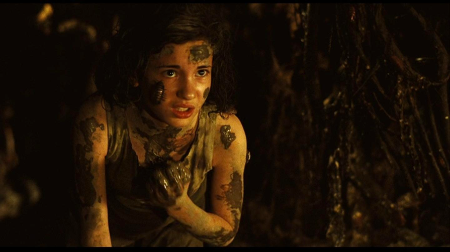
Campbell writes that "if anyone—in whatever society—undertakes for himself [sic] the perilous journey by descending, either intentionally or unintentionally, into the crooked lanes of his own spiritual labyrinth, he soon finds himself in a landscape of symbolical figures" (2004, 101). Del Toro chooses the amorphous space of the labyrinth as the setting for the hero's journey, where Ophelia must undergo a series of tests, tasks, or ordeals that are necessary to begin the transformation. Here Ophelia will engage in a multitude of tasks that are intricately linked to the unsavory elements of the abject, such as rickety insect-like fairies, an oversized slime-spewing toad, and a child devouring a skeletal pale man. In the following image, she is seen crawling through mud, with cockroach-like insects slithering all over her body. Her first mission is to retrieve the golden key from a large, grotesque toad whose ingestion of bugs causes him to grow so immensely that he strangles the life forces of the tree.
Scene from El laberinto del fauno with Ophelia in the tree
© Estudios Picasso/Tequila Gang/Esperanto Filmoj
Ophelia is instructed to feed the toad three pellets that cause him to vomit a repellent mucous-laden film that is flung onto the frightened girl's body. He then deflates into a slow and ineluctable death, leaving a puddle of bug-ridden vomit. Ophelia quickly retrieves the key and takes her leave. The abject components of this scene produce primal feelings of disgust in the spectator, pointing to deeper layers of meaning that lie beyond the superficial exterior.
The mission related to the toad recalls ancient myths of dragons in European tradition that represent a deeper psychological growth of the individual. Campbell argues that the dragon, which hoards and protects monetary goods and virgins for which he has no use, is representative of one's own binding of oneself to one's ego. In an interview given before his death (included in The Hero with a Thousand Faces), Campbell identifies the dragon (ego) in these myths as the limitations that we set for ourselves when we follow too strictly the script of the social order. He believes that the old skin has to be shed before the new one can come, so that we can experience the life that is waiting for us (148-49). This task, which takes place below the earth's surface at the depths of the roots of the tree, represents the break from the limitations established by the parallel realm of the Captain, providing a space in which the hero can release a new level of consciousness relegated to the unconscious space of the labyrinth. This is perhaps most clearly exemplified with the parting words of the doctor (Álex Angulo) to the Captain, right before his execution: "Es que obedecer por obedecer, así, sin pensarlo, eso es sólo para gentes como usted, Capitán" (To obey without thinking, just like that, well, that's only something that people like you can do, Captain).
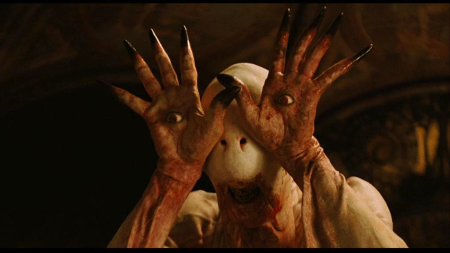
Another crucial scene relaying elements of the abject is the frightening pale man that almost devours Ophelia in the labyrinth. Ophelia is instructed to enter a luxurious banquet room in the middle of the night and to use the key in order to retrieve a golden dagger. Using the magical chalk given to her by the faun, she slips from reality into the fictitious world of demons and encounters a frightening pale man sitting at the table. The banquet room of the underground is filled with images of wealth and abundance absent in the parallel world above. The gilded walls and religious imagery of the palace surround a banquet table full of delicacies, including delectable fruit, an array of meats, and red wine. As Ophelia completes her task, she reaches over and grabs a handful of grapes, explicitly disobeying the instructions of the faun. Campbell points out the prevalent theme in the monomyth of eating the forbidden fruit, which ostensibly produces serious repercussions. Ophelia's transgressions in this case cause the pale man to slowly, yet methodically, rise from the table and place his detached eyeballs in his hands, as seen in the image below. Distracted by the fairies that fly about him, he reaches up and grabs them one at a time, ripping their bodies in half with his small, sharp teeth. The pale man proceeds to pursue Ophelia in an effort to consume her, as he has just done to the innocent fairies that served as Ophelia's guides.
This scene reveals complex implications of postwar Fascist Spain, given the religious imagery that prevails in the room and the abundance of food available, while rations are being distributed in a poverty-stricken nation. Franco's political posture took on crusade-like dimensions following the outbreak of the Civil War in 1936, when he received undying support from two bishops of Salamanca. In a long pastoral letter entitled "The Two Cities," the clerics demonized the "earthly" ideas of the Republic against the "celestial city" of the Nationalists, where the love of God, heroism, and martyrdom were the rule (Preston 184-85). Del Toro provides a not-so-subtle criticism of the subsequent complicity of the Roman Catholic Church in the cruel machinations of the Franco regime, epitomized here in a setting of horror and contradictions. Furthermore, parallelism with the patriarchal positioning of the Father at the head of the table, which will be cross-referenced with Captain Vidal in an upcoming scene, provides a frightful premonition of the conscious realm in which Ophelia resides.
One of the more immediate and compelling aspects of this scene, however, is the abject depiction of a repulsive, faceless man who has just devoured two fairies and continues to chase Ophelia as blood is dripping from his mouth. The skeletal image covered loosely in wrinkled, sagging skin provokes reactions of fear and horror on the part of the spectator, partly because he recalls ghostly impressions of the corpse, but also because he attempts to pull Ophelia into the frightful world of the unknown, or what Kristeva refers to as the most abject space of all—death.
The Pale Man in the film El laberinto del fauno
© Estudios Picasso/Tequila Gang/Esperanto Filmoj
Horror and anxiety of the unknown are recurring themes in this film that can be better defined within H. P. Lovecraft's definition of cosmic horror in "Supernatural Horror in Literature" (1927): "A certain atmosphere of breathless and unexplainable dread of outer, unknown forces must be present; and there must be a hint … of that most terrible conception of the human brain—a malign and particular suspension or defeat of those fixed laws of Nature, which are our only safeguard against the assaults of chaos and the daemons of unplumbed space" (quoted in Hodgen 19). Del Toro also addresses the level of fear in the film as he poignantly comments: "It's like doing a deep tissue massage to the soul, to try and reach the point where you will react to the violence and say, 'Oh, my God.' It's so over-the-top that it will affect you. And the fantasy is also so over-the-top that it will affect you" (Murray). The phobic sensations produced as a reaction to this horror refer to Kristeva's theories of the abject as it produces subliminal sensations, "triggering the eruption of the Real into our lives," and recharges "what is essentially a pre-lingual response" (1982, 6).6 This prelingual response brings the spectator to the borders, or that abysmal line between life and death, allowing them to reevaluate the rational order of the parallel realm, governed by the even more frightful actions of Captain Vidal.
Captain Vidal's cruelty in the film is unprecedented, dissolute, and even supersedes the horror provoked by the grotesque creatures in the underground world of the fairy tale. The use of the fairy-tale villain within the the post-Civil War historical context accentuates the brutality against the Republicans in Fascist Spain. On more than one account, the spectator discerns the Captain's ruthless systematic torturing practices, where he displays a shuddering sense of cruelty and power over his victims.
In one particular scene, Vidal offers the recently captured Republican the chance to escape the torture session if he can count to three without stuttering. A sense of hope and further anxiety mounts as the spectator prays for the prisoner's ability to move beyond the number two, which he arrives at with extreme effort. He is unsuccessful, of course, and the gruesome torture session begins. Vidal triumphantly takes out his arsenal of weapons as he explains the intimate process of torture to the prisoner, relishing in the ceremoniousness of this task. One might argue that the spectator is spared the more grotesque details as the camera abruptly cuts to the next scene. Others might find that scene to be even more disturbing for its suggestive aspects of abject imagery, related to bodily fluids, following the torture session. In any case, the camera flashes to the muddy streets of this military camp, where Vidal now stands washing the human blood of his victim off his hands in the pouring rain. This scene provides a public spectacle of violence related to the abject components of bodily fluids, specifically those of the recently tortured and physically maimed Republican, who now desperately pleads with the doctor for his own death. The lingering close-up shots of his battered face, featuring a string of blood hanging from his swollen lip, allow the spectator to perceive more clearly "the sickly, acrid smell of sweat and of decay that offers us more palpable approximations of death" (Kristeva 1982, 3).
The exclusive and excessive detail in the film given to bodily fluids and defilement associated with death "bring[s] us to the border of our condition as a living being" (Kristeva 1982, 3), which is a positioning that Ophelia represents throughout the film. Her role as a lost princess of another world trying to regain her throne places her in a precarious space on the border of life and death, fiction and reality, straddling the abject space of the primal animalistic order of the faun and the symbolic world of the Captain. Del Toro juxtaposes this prelingual, presymbolic realm associated with the abject with the rational order of the law under the rule of Franco in order to reveal the even more primitive and animalistic primal urges toward violence executed by the despotic figure of Captain Vidal.
The Captain, who is representative of Fascist Spain, reveals a compulsive adhesion to law and order in the film that is perceived as detrimental and even pathological. His repudiation of the Other can be linked to his own process of psychosexual development, demonstrating significant conflicts between the ego and the superego. In The Ego and the Id, Freud argues that the more intense the Oedipus complex was, and the more rapidly the subject succumbs to repression (under the influence of discipline, religious teaching, schooling, and reading), the more exacting later on is the domination of the superego over the ego (quoted in Felluga). He concedes that because of its connection to the id, the superego has the ability to becomeexcessively moral and thus lead to destructive effects. In the film, Captain Vidal exercises excessive activity of the superego in his repression of the abject Other, which in this case points to the surviving Republican faction that takes refuge in the mountains.
Stephen Frosh points out that the seeds of masculine sexuality in Western culture are embedded deeply in relationships, both concretely and figuratively, and are founded on domination and control. They are also found in a cultural order "built around fantasies of wholeness and rational perfection, safe from dissolution but always bereft of emotion; and they are to be found in specific family relationships in which asymmetry and denial of femininity are structuring dimensions" (115). In this film, Vidal's atavistic psychosexual development, constituted in Franco's Fascist Spain, is representative of the fantasy of a homogenized nation, founded on the repudiation of the Other and inspired by a return to a glorious past. Ophelia's journey into the borderless space of the abject disturbs these illusions of wholeness that had become the driving principles of the national imaginary of post-Civil War Spain and opens up a space for a new level of consciousness.
The Rebellion of the Magic Rabbits
Ariel Dorfman's La rebelión de los conejos mágicos (The Rabbits' Rebellion) is a fairy tale that tells the story of a similarly ruthless dictator in Chile, General Augusto Pinochet. This children's book draws on the theme of the "Big Bad Wolf" in its tale of an evil wolf who proclaims himself king, declaring himself to be the Lobo, el lobísimo, or el gran loberador.7 The epithets that the Lobo creates for himself call attention to the significant role that language plays in the construction of a discourse designed to eliminate the Other: "Cuando los lobos se apoderaron del país de los conejos, lo primero que hizo el jefe de la manada fue proclamarse rey. Lo segundo fue anunciar que los conejos ya no existían" (When the wolves conquered the rabbits, the first thing the leader of the pack did was to proclaim himself king. The second was to announce that the rabbits had ceased to exist [5]).8 As in all totalitarian regimes, the control of the body politic is enforced through violence, fear, and the manipulation of language, and, as happens also in del Toro's film, the wolf demonizes his enemies in his construction of a new nation. The rabbits are not only prohibited from society, they are also eliminated from speech and images:
Y para asegurarse de que lo obedecerían, el nuevo rey de los lobos se puso a revisar todos los libros del reino con un grueso lápiz negro hasta que, rayando palabras y arrancando dibujos, se dio por satisfecho, convencido de que sus enemigos habían desaparecido para siempre.
Just to be on the safe side, the new Wolf King went over every book in his realm with a big black pencil, crossing out words and tearing out pictures of cottontails until he was satisfied that not a trace of his enemy remained. (6)
Dorfman's fairy tale is also linked to the abject in that it represents the negation of the Other and, therefore, implicates the primal repression allocated to the space of the unconscious. The Republicans and the rabbits refer to "a dialectics of negativity" in that their lives are not sustained by the desire of the objects in power. Their dynamics challenge the theory of the unconscious, seeing that the latter is dependent upon a dialectics of negativity (Kristeva 1982, 7). Both groups exist outside of the symbolic realm because they are repudiated from it. Although the "unconscious" contents are excluded, Kristeva argues that they remain inside the symbolic in a strange fashion: "not radically enough to allow for a secure differentiation between subject and object, and yet clearly enough for a defensive position to be established" (7).
In an effort to delineate boundaries between the self and Other within the context of the Law, the "Gran Loberador" hires a photographer, the mono (monkey), to take pictures of his magnificence, including the many cruel acts that he inflicts on the inhabitants. These pictures are to be dispersed all over the land, thereby revealing the implementation of a culture of fear through linguistic and visual imagery. The wolf's discourse is further reinforced by tying loudspeakers onto the birds' necks, resulting in a broader, more expansive spectrum of his ruling discourse that is now descending from the sky. Besides the mona chiquita, the birds are the only other inhabitants that admitted to the existence of the conejos, as they had reported seeing them with their aerial vision. The wolf drowns out the witnesses' voices, in the same way that the monkey was instructed to erase or "hacer desaparecer" (make disappear) the rabbits from the photographs.
Kristeva points out that the mechanisms of the abject come into play when "an unshakable adherence to Prohibition and Law" is exercised, causing "that perverse interspace of abjection … to be hemmed in and thrust aside" (1982, 16). She refers to the "deject" as the one who strays from the borderlines, or the seemingly fixed positions of the conscious and the unconscious, and wishes to know its abjections: "Often, moreover, he includes himself among them, thus casting within himself the scalpel that carries out his separations" (8). The deject, whom she considers "as equivalent to a Third Party," strays, while actively demarcating his universe whose fluid confines are described as "essentially divisible, foldable, and catastrophic" (8). InEl laberinto del fauno, Ophelia strays into the world of the labyrinth, engaging with the abject components surrounding the faun. Armed with the magical tools of keys, chalk, and her hero's quest, she defies boundaries between fiction and reality and hangs in the balance of the sublime.9
The monita chiquita, the monkey's daughter, also functions as the deject, and in her ability to create a space for the rabbits within the current oppressive order, she is also the hero of this story for children. By refusing to accept the current rational order, in this case the elimination of the rabbits, she disturbs the border between the Law of the Father and the repressed components cast into the dialectics of negativity. Like Ophelia, she serves as the link to the unconscious, and through her dreams she both communicates and identifies with the rabbits: "percibiendo en sus sueños la verde lluvia de sus voces que canturreaban cerca, entre los árboles vecinos, en túneles subterráneos, y cuando despertaba, a su lado siempre había un minúsculo regalo" (But in her dreams she perceived hearing the green rain of their voices singing nearby, among the neighboring trees, in underground tunnels, and when she woke there was always a small gift beside her bed [my translation]). The fluid poetic trope of synesthesia in reference to the "verde lluvia" and the onomatopoeic qualities of the "voces que canturreaban" deviate from rational thinking and represent the presymbolic space of the semiotic, which in this story takes place in the unconscious space of the dream.
Campbell uses the image of the belly of the whale in his explication of the hero's passage of the magical threshold, which he describes as a "transit into a sphere of rebirth" (2004, 83). Instead of conquering or conciliating power in the threshold, the hero is swallowed into the unknown. While the abject components of El laberinto del fauno are representative of the repressed space of the unconscious, providing Ophelia with an unfamiliar terrain in which to carry out her trials, the monita chiquita emerges into the unconscious through dreams. Her innocence as a child and her proximity to the sublime offer her a privileged status of seeing things that were otherwise prohibited in the legal discourse of the Lobo. Despite the fact that she is told not to speak about these things by her mother, she pleads with her father to bring her a picture of her beloved friends, asking, "Tú me vas a traer una foto de Conejos algún día, ¿no papá?" (You'll bring me a picture of them someday, won't you Dad? [10]). Like del Toro, Dorfman creates a labyrinth through the use of mise en abyme. The rabbits are represented in a visual reproduction (photograph) of a repressed image portrayed within the context of a fairy tale that merges with the subliminal space of dreams. The child's interaction with the rabbits and her insistence to represent them in language and through the visual imagery of a photo requested from her father represent a break in the linguistic discourse mandated by the Lobo.
Kristeva relies on the investigations of Freud concerning primal repression, referring to that which can be repressed but not held down (1982, 13). While the symbolic function governs unity, the semiotic function demonstrates the heterogeneity of meaning, and much like the movement in dance, it erupts into language through "fissures" rather than in the denotative meanings of words. In Dorfman's work, the rabbits are considered to be the abject Other and are initially repressed into the collective unconscious. Slowly but surely, they systematically emerge in discourse through the fissures of language—first through dreams, then through images, until they are able to gnaw away at the throne of the soon-to-be "Gran Loberador" and, finally, "el mundo estaba lleno de conejos" (the world was full of rabbits).
Return Home: A Transformation of Consciousness
A closer interpretation of El laberinto del fauno and La rebelión de los conejos mágicos, with reference to Campbell's hero and Kristeva's abject, features even more profound destabilizing considerations of consciousness made evident in the climax and conclusion of each work. According to Campbell, the theme of self-sacrifice in the hero's quest is essential in the fulfillment of a "transformation of consciousness" (2004, 65), which is of course the ultimate goal of the hero as seen in the legacies of Moses, Buddha, Jesus, and Mohammed. Kristeva points to similar goals that are accomplished through the abject and are indicative of Ophelia's quest. She argues that abjection is a resurrection that has gone through death (of the ego). It is an alchemy that transforms the death drive into a start of life, of new significance (1982, 15). Ophelia eventually retreats into the presymbolic realm through death, provoked by her resistance to obey the rules assigned to her by both Captain Vidal and Pan. In what appears to be a display of Freudian tendencies of the death drive, she gradually yet persistently moves toward her own demise, which culminates with her decision to save her young brother from being sacrificed, despite Pan's demands.
Ophelia's decision both to take the child from her vicious stepfather Vidal and to refuse to offer the innocent newborn to the faun, as a sacrifice necessary to reclaim the throne, marks her resistance to both realms, indicating an agency that is the definitive test for the hero. The ultimate aim of the quest, states Campbell, "must be neither release nor ecstasy for oneself, but the wisdom and the power to serve others" (1988, xv). According to Campbell's theorizations, the hero's apotheosis occurs when he or she realizes a godlike status through death by moving beyond oppositions and entering into a state of divine knowledge, love, compassion, and bliss: a stage that has striking similarities with Kristeva's semiotic chora, or the return to the presymbolic dyad with the mother (Campbell 2004, 157).10 This stage is depicted in a unique way in del Toro's film as he combines allusions to popular universal myths of the search for the father with Ophelia's return to the presymbolic stage, or the reunion with the mother. However, in this film, it is Ophelia's father who awaits her in the prelinguistic space of the "subterráneo" (underground), accompanied by her mother, the faun, and the fairies. By providing representations of male, female, and animal in Ophelia's "return home," del Toro disturbs conceptualizations of gender in both traditional literary convention and psychoanalytical thought.
This return home, which is realized through the hero's fulfillment of the tasks, is described by Campbell as a rebirth or an awakening in another realm (2004, 157). The end of El laberinto del fauno, therefore, comes full circle as we recall the opening narration of a princess who dreamt of the world of humans ("soñaba con el mundo de los humanos"). The realm formerly identified as rational is now constituted as the oneiric sphere, which is posited as the repressed discharge of the unconscious of a more civilized world, formerly related to the abject in the corpus of the film. Instead of providing a clear-cut conclusion, del Toro pulls us into his labyrinth as he blurs the fine lines between fiction, reality, and dream in a realm devoid of binary oppositions.
The end of Dorfman's children's story is also instrumental in disturbing traditional thoughts of time and space, as he introduces significant conflicts between fiction, reality, and dream. The image on the back cover of the book provides a provocative positioning of the rabbit that was formally relegated to the unconscious space of dream. The rabbit is now situated outside of the frame of the picture looking in as he or she steps on the passive body of the Lobo, formerly representative within the conscious realm of the dictatorship. The fairy tale just told is now represented as the world captured within the photo, providing an inversion of our initial perception of the story. The rabbit currently occupies the space of the subject of the gaze within the rational world of the observer, who is now in control.
Despite the fairy-tale setting, most readers would have identified more readily with the world of the wolf, because it represents a closer representation of our reality than the dream world of the rabbits. We are further displaced as we see the rabbit look at a picture that represents a fairy tale in which a dream has manifested itself as reality. In this way, we become involved in the irrational timelessness of the fairy tale, unsure of our own current positioning. One must consider a further decentering of this image as it is located not within the text, but on the back cover of the book, placing it outside of the frame of the story. Dorfman has blurred the lines between fiction and history, inside and outside, and the real and the imaginary, thereby embracing, as del Toro has, the borderless elements of the abject in his introduction of a new level of consciousness.
Memory and Trauma
As heroes of these journeys through the space of the unconscious, Ophelia and themonita chiquita engage with themes of memory, death, and mourning relegated to the postdictatorial era in Spain and Chile. In La rebelión de los conejos mágicos, the little girl's connection with the rabbits, which occurs through the unconscious space of dreams, clearly indicates a reading of memory or mourning of the disappeared victims of the Southern Cone and the denial of the government to recognize their disappearance or death throughout the dictatorship and in the transitional years toward democracy. Dorfman's fairy tale was published in 1986 with the Argentine press Ediciones de la Flor. Although Pinochet was still very much in power during this time period, the stifling economic crisis of the 1980s in Chile allowed room for political dissent (Lagos, Munoz, and Slaughter 28). Dorfman saw an opportunity to address one of the more pressing issues of the nation, which was the disappearance of the opposition in the early years of the regime and the lack of information concerning the many victims of the repressive government. The Pinochet regime wielded a national history very different from the one witnessed by victims and their families. Their experiences had been erased from the national narrative in the same way in which, in Dorfman's story, the photographer uses a special liquid in order to "hacer desaparecer cualquier detalle que pudiera desagradar a un cliente" (to erase any detail that might bother a client [16]). Despite the wolf's efforts, the rabbits reappear through the unconscious space of dreams and ultimately form part of the discourse of this fairy tale.
The oneiric associations between the young girl and the rabbits in La rebelión de los conejos mágicos point to more complex interpretations than those traditionally found in fairy tales. The rabbits in this story for children represent the outlawed opposition during the Pinochet regime, which consisted of the leftist parties that had constituted Allende's Popular Unity coalition. During a seventeen-year reign of terror (1974-90), the government instilled a culture of fear and violence directed against the opposition, resulting in torture, disappearances, and exile of many inhabitants, including family members and civilians. The overall repression of crimes committed by the government against the people resulted in the suppression of many victims' stories, a phenomenon that trauma specialists argue will eventually resurface into the national spectrum, manifesting itself in different ways.11 Dorfman, who is better known for his play turned Hollywood movie Death and the Maiden (1990), uses the tropes of music and hysteria in order to uncover the suppressed voices of the victims, including those of the "desaparecidos," in postdictatorial Chile. In the play, Paulina provides a vehicle to release the repressed voices of many victims through a temporal "hysterical" attack of reprisal against a man she believes to be the perpetrator of violence against her.
In Dorfman's fairy tale, the rabbits, which existed on the periphery ("entre los árboles vecinos" [among the neighboring trees] or "en túneles subterráneos" [in underground tunnels]), emerge into the symbolic through magic. Motivated by their desire to communicate with the story's hero, they enter into her dreams on a nightly basis: "Habían aprovechado aquella facultad mágica que les permitía atravesar murallas, como si fueran agua, para pasar por su habitación justo antes de que amaneciera cada mañana" (They had taken advantage of that magical ability to cross through walls, as if they were water, in order to pass through her bedroom just before daybreak each morning [my translation]). As proof of their existence, the rabbits leave the young girl a gift, thereby validating their existence despite the government's efforts to exclude them from the national consciousness.
Del Toro also addresses themes of trauma and memory in El laberinto del fauno. At the film's beginning, Ophelia loses her memory when she enters the world of the humans: "Una vez en el exterior, la luz del sol la cegó y borró de su memoria cualquier indicio del pasado, la princesa olvidó quién era, de donde venía" (Once outside, the brightness blinded her and erased her memory... She forgot who she was and where she came from). The trials and victories related to the hero's journey are carried out in order to recover her memory and reclaim the throne of the underground. In her article, "Blood of an Innocent," Mercedes Camino argues that the characters Mercedes (Maribel Verdú) and Ophelia provide connections with the maquis, the anti-Fascist resistance group who fought from the mountainous areas of Spain following the Civil War (48).12 According to this critic, Mercedes's contact with the rebels and Ophelia's parallel struggles within the labyrinth unleash the many stories of those unnamed participants who offered refuge and aid to the maquis and were often tortured and murdered. Through these key characters, the movie pays homage to the unidentified voices that supported the guerrilla movement and therefore form an active and integral part of the historiography of post-Civil War Spain (49). Camino maintains that the true dimensions of the struggle and repression of this anti-Fascist group are only slowly coming to light in twenty-first-century Spain (62).
Recent investigations of trauma bring to light the critical role that memory plays in the recuperation of national trauma. Shoshana Felman and Dori Laub in Testimony and Cathy Caruth in Unclaimed Experience point out the importance of confronting trauma in order to avoid the manifestations of the traumatic event on the psyche. As we have seen, the repressed voices of the opposition in these stories reveal a manipulation of language and history on the part of the governing forces that did not allow accounts other than their own to be told or to be heard. Del Toro and Dorfman choose to draw on the innocence of the young female hero within the context of the genre of a fairy tale in their provocation of a "transformation of consciousness" of the ways in which we interpret the past, present, and future. Their appropriation of the presymbolic realm is vital in disturbing the binary oppositions that make up the rational sphere of authoritative discourse, providing a space in which meaning can be renegotiated toward a reconciliation of opposing parties that encompass the national spectrum. The extensive investigations of Joseph Campbell show us that fables, tales, and myths provide the foundation of meaning in culture, influencing us in ways that we are unaware of. In this sense, Dorfman and del Toro go the root of culture in order to tell a new kind of fairy tale, one that heeds against singular interpretations of meaning and truth and leaves space for the multifaceted dimensions involved in storytelling.
1. This theory is also addressed in Mikhail Bakhtin's 1941 essay, "Epic and Novel: Towards a Methodology for the Study of the Novel" (included in The Dialogic Imagination), where he differentiates between the epic and the novel, arguing for the malleability of the latter. Unlike the rigid consistency of the epic, Bakhtin sees the novel as a more flexible genre, capable of engaging with contemporary reality and possessing an ability to reconceptualize the individual in complex ways that interrogate his [sic] subjectivity and offer the possibility of redefining his image. A coincidental feature of the theorizations of both Bakhtin and Campbell is the relevance of the evolution of the hero within the story, which in turn serves as a catalyst toward a new beginning for a more extensive worldview.
2. In this interview, del Toro states that the girl is reborn at the end of the movie: "She is really going back to the belly of her mother." He also differentiates the bright vivid colors of the magical world, which are scarlet and golden, from the cold and uninviting colors of the real world. See Murray, "Guillermo del Toro talks Pan's Labyrinth."
3. English translations of the script are taken from the Daily Script website, accessed October 15, 2011. http://www.dailyscript.com/scripts/PansLabyrinthEnglishScreenplay.pdf.
4. In "Women's Time," Kristeva traces the evolution of feminism according to feminist reactions to maternal or cyclical time, based on repetition and eternity, and to linear time, which has its basis in history and language. While the notion of cyclical time has been instrumental in developing a voice for second-wave feminists, Kristeva sees the danger in falling into the same marginalizing and exclusionary practices that feminist thought had initially tried to discard (190). She calls for a new wave of feminists who can reconcile "maternal" time with linear time, by emphasizing "the relativity of … symbolic as well as biological existence" (210), a goal which to a large extent is carried out in the two texts discussed in this investigation.
5. Ophelia's madness and association with water also became a chosen theme for nineteenth-century writers and artists. Bram Dijkstra points out that although Ophelia was a secondary character in Shakespeare's Hamlet, renditions of her "flowery madness" and "watery death" on canvas reinforced male fantasies of feminine dependency (42).
6. Kristeva offers an alternative model to Lacan's mirror stage and his order of the Real, the Imaginary, and the Symbolic. Lacan defines the Real as the state of nature from which we have been forever severed by our entrance into language. Kristeva adds to Lacan her sense that language is ultimately a fetish, an effort to cover over the lack inherent in our relation to death, materiality, and the abject (Felluga).
7. In Spanish, superlative endings such as -ísimo can be attached to many adjectives in order to intensify the meaning of the modified word. While this suffix is not typically used with nouns, Dorfman employs the terms el lobísimo or el gran loberador to emphasize the self-aggrandizement of the wolf in his regime. In the English version, The Rabbits' Rebellion, Dorfman creates a similar effect using the following terms: "His Wolfinity" (26), "His Wolfhood" (33), and "The Wolfiest of Wolves" (53).
8. I suspect that in an attempt to further resist confines of space and time of the rational order,
Dorfman chose to omit page numbers in the original Spanish version of his fairy tale. Unless otherwise specified, all English translations of this work are taken from The Rabbits' Rebellion. While Dorfman himself is the author of the English version of La rebelión de los conejos mágicos, the minor additions and changes he made to the translated text occasionally result in a distinct reading of the original work. My own translations are provided when such alterations in the text occur.
9. According to Kristeva, the sublime collapses distinct boundaries with abjection: "The abject is edged with the sublime. It is not the same moment on the journey, but the same subject and speech bring them into being ... the sublime is a something added that expands us, overstrains us, and causes us to be both here, as dejects, and there, as others and sparkling" (1982, 11-12).
10. At this stage (0-6 months of age), the child does not distinguish its own self from that of its
mother or even from the world around; rather, it spends its time taking into itself everything that it experiences as pleasurable without any acknowledgment of boundaries (Felluga).
11. In his investigation of trauma in postdictatorial Argentina, Antonius C. G. M. Robben argues that the ongoing conflicts of memory construction are surface manifestations of unresolved traumas about past atrocities (122). Among the many support groups and organizations that have emerged in Chile following the dictatorship are the Rettig Commission, Reparation and Reconciliation Corporation, Derechos Chile, and Agrupación de Familiares de Detenidos Desaparecidos.
12. The word maquis, a short version of maquisards, was first coined in Corsica where it referred to the mountainous landscape that harbored the nationalist fighters on the island. Like their Corsican counterparts, the Spanish maquis mostly fought from and sought refuge in the mountainous areas of Spain (Camino 48).
Bakhtin, M. M. The Dialogic Imagination. Edited by Michael Holquist. Translated by Caryl Emerson and Michael Holquist. Austin: University of Texas Press, 1981.
Camino, Mercedes. "Blood of an Innocent: Montxo Armendáriz's Silencio Roto (2001) and Guillermo del Toro's El laberinto del fauno (2006)." Studies in Hispanic Cinemas 6, no. 1 (2010): 45-64.
Campbell, Joseph. The Hero with a Thousand Faces. Princeton: Princeton University Press, 2004.
———. The Power of Myth. With Bill Moyers. New York: Doubleday, 1988.
Caruth, Cathy. Unclaimed Experience: Trauma, Narrative, and History. Baltimore: Johns Hopkins University Press, 1996.
Del Toro, Guillermo, dir. El laberinto del fauno (Pan's Labyrinth). Estudios Picasso, Tequila Gang, and Esperanto Filmoj, 2006. DVD. Madrid: Telecinco, 2007.
Deveny, Thomas. "Once upon a Time in Spain in 1944: The Morphology of El laberinto del fauno." Cine y...: Journal of Interdisciplinary Studies on Film in Spanish/Revista de Estudios Interdisciplinarios Sobre Cine en Español 1, no. 1 (2008): 1-12.
Dijkstra, Bram. Idols of Perversity: Fantasies of Feminine Evil in Fin-De-Siècle Culture. New York: Oxford University Press, 1986.
Dorfman, Ariel, and Juan Marchesi. La rebelión de los conejos mágicos. Buenos Aires: Ediciones de la Flor, 1986.
———, and Chris Riddell. The Rabbits' Rebellion. London: Doubleday, 2001.
Felman, Shoshana, and Dori Laub. Testimony: Crises of Witnessing in Literature, Psychoanalysis, and History. New York: Routledge, 1991.
Felluga, Dino. "Modules on Kristeva: On Psychosexual Development." Introductory Guide to Critical Theory. Purdue University English Department, accessed November 10, 2010. http://www.cla.purdue.edu/english/theory/psychoanalysis/kristevadevelop.html.
Frosh, Stephen. Sexual Difference: Masculinity and Psychoanalysis. London: Routledge, 1994.
Hanley, Jane. "The Walls Fall Down: Fantasy and Power in El laberinto del fauno." Studies in Hispanic Cinemas 4, no. 1 (2007): 35-45.
Hodgen, Jacob. "Embracing the Horror: Tracing the Ideology of Guillermo Del Toro's Pan's Labyrinth."Velox: Critical Approaches to Contemporary Film 1, no. 1 (2007): 15-30.
Hogle, Jerrold E. "Frankenstein's Dream: An Introduction." In Frankenstein's Dream, edited by Jerrold E. Hogle. Romantic Circles Praxis Series. Accessed March 23, 2011. http://www.rc.umd.edu/praxis/frankenstein/hogle/hogle.html.
Kristeva, Julia. Powers of Horror: An Essay on Abjection. Translated by Leon S. Roudiez. New York: Columbia University Press, 1982.
———. "Women's Time." In The Kristeva Reader, edited by Toril Moi, 187-213. New York: Columbia University Press, 1986.
———. "The Subject in Process." In The Tel Quel Reader, edited by Patrick French and Roland-François Lack, 133-77. London: Routledge, 1998.
Lagos, Ricardo, Heraldo Munoz, and Anne-Marie Slaughter. "The Pinochet Dilemma." Foreign Policy114 (1999): 26-39.
Murray, Rebecca. "Guillermo del Toro Talks about Pan's Labyrinth." About.com: Hollywood Movies. Accessed February 28, 2011. http://movies.about.com/od/panslabyrinth/a/pansgt122206.htm.
Preston, Paul. Franco: A Biography. New York: Basic Books, 1994.
Robben, Antonius C. G. M. Political Violence and Trauma in Argentina: The Ethnography of Political Violence. Philadelphia: University of Pennsylvania Press, 2005.
Smith, Paul Julian. "Pan's Labyrinth (El laberinto del fauno)." Film Quarterly 60, no. 4 (2007): 4-9.
Stern, Steve J. Remembering Pinochet's Chile: On the Eve of London, 1998. Durham: Duke University Press, 2004.