Code of Student Conduct
Student Conduct Program: Code of Student Conduct
University of Massachusetts Dartmouth Student Conduct Program Mission
The University of Massachusetts Dartmouth Student Conduct Program is committed to fostering an inclusive campus community that promotes active and responsible citizenship through an educational and developmental process that values respect, responsibility, and accountability for all University Community members.
University of Massachusetts Dartmouth Student Conduct Program Goals
- Promote a consistent, fair, and timely student conduct process that encourages participation of the campus community while holding students accountable for their choices.
- Educate the campus community about student’s rights and responsibilities as a member of the University community.
- Assist students in seeking out resources for learning and living that enhance the student’s overall well-being and help students think critically in their decision-making.
- Facilitate on-going comprehensive conduct related training for students, staff, and faculty that are involved in the student conduct program.
University of Massachusetts Dartmouth Student Conduct Program Outcomes
As a result of going through the student conduct program, students will be able to:
- Explain why University policies exist and why the University community is concerned about their choice(es).
- Understand the impact of their behavior and decision-making on themselves and the community.
- Communicate their personal responsibility for their behavior within the University community.
- Identify ways to address their actions(s) so that their choices do not negatively impact their educational goals and success in the future.
University of Massachusetts Student Conduct Program Authority and Jurisdiction
The Chancellor of University of Massachusetts Dartmouth’s Student Conduct Program has approved and delegated authority and responsibility for the administration of the Student Conduct Program to the Vice Chancellor of Student Affairs and student academic dishonesty to the Provost. The Vice Chancellor of Student Affairs has delegated the administration of the Student Conduct Program to the Office of Community Standards within the Division of Student Affairs. The Office of Community Standards has the authority and responsibility to implement and enforce the policies and procedures related to student behavior and conduct. This responsibility includes formulating and implementing appropriate policies and procedures, in conjunction with other appropriate University departments, for the consideration of conduct complaints, infractions, and the imposition of outcomes in an efficient, consistent, legal and equitable manner. The University reserves the right to take any necessary and appropriate action to protect the safety and well-being of the campus community.
The Code of Student Conduct applies to student conduct that occurs at the University of Massachusetts Dartmouth and its properties and at any event sponsored by the University of Massachusetts Dartmouth. For purposes of student conduct, the University considers the individual to be a student when they are accepted or enrolled in a University course or program, this includes part-time, full-time undergraduate, graduate and law students. Each student shall be responsible for their personal conduct from the time of admission through the awarding of a degree, including but not limited to, conduct which occurs before classes begin, after classes end, during the academic year, and during any other time between the date in which the University accepts or enrolls the student and the date on which the student is awarded a University degree. If a student withdraws, the University reserves the right to initiate and/or resolve any pending conduct matters. In the event of serious alleged violation(s) committed while still enrolled but reported after a student has graduated, the University reserves the right to initiate the conduct review process. If the former student is found responsible, the University may revoke the student’s degree and/or impose other outcomes.
The University cannot, as a practical matter, monitor or control off-campus conduct of University of Massachusetts Dartmouth students, nor does it attempt to assume any duty to do so. However, if a University official receives notice of off-campus conduct that is inconsistent with University Policies that impacts the campus community or poses safety concerns, the University may take action against the student(s) involved under the Code of Student Conduct.
The Code of Student Conduct applies to any student group which may be addressed by any University department or unit and/or the Student Conduct Program. Student groups, as well as their members and other students, may be held collectively and/or individually responsible for policy violations. The officers or leaders of a student group may be held collectively and/or individually responsible when such violations are committed by persons associated with the student group who have received consent or encouragement from the student group’s officers or leaders or if those officers or leaders knew or should have known such violations were being or would be committed. The University may direct officers or leaders of a student group to take action intended to prevent or end such violations by the student group or by any persons associated with the student group. Failure to comply with a University directive may be considered a violation and additional and/or further disciplinary action may be taken.
The conduct review process may be initiated when an alleged violation potentially violates both criminal law and/or the University policies. The process is independent and may be carried out prior to, simultaneously, or following a civil or criminal proceeding at the discretion of the Director of Community Standards or designee. Agreements or findings finalized under the Code of Student Conduct shall not be subject to change should civil or criminal charges, regarding the same acts that prompted the Office of Community Standards, be dismissed, reduced, or resolved in favor of or against the criminal law defendant.
University Community Standards (Code of Student Conduct Policies)
The following list of behaviors or attempted behaviors are intended to represent the types of acts that constitute violations of the Code of Student Conduct. Although the list is extensive, it should not be regarded as exhaustive. All community members are responsible for knowing and observing all University policies. For purposes of this Code of Student Conduct, the definitions are as follows.
Academic Integrity: See UMass Dartmouth Academic Integrity Policy for definitions, violations, and process.
Altered Identification: Anyone found in possession of an altered form of identification, or anyone altering a form of identification, or anyone altering a form of identification of another person.
Bicycle, Scooter, and Micro-Transportation: Any reckless act, safety concern, or property damage whileoperating/using bicycles, scooters, or other micro-transportation devices is prohibited.
Complicity: The act of assisting another person in the commission or attempted commission, of a violation of the Code of Student Conduct. For the purpose of this document, this also includes hosting a guest who commits a violation or being in the presence of a violation and failing to report.
Destruction of Property/Vandalism: Damaging, destroying, or misusing University buildings, grounds, equipment, educational materials, or the personal belongings of others is prohibited. Includes, but is not limited to, the damage or misuse of University property or property belonging to others, destruction/removal of advertisements, graffiti, or littering. Damages caused by students to University owned or operated property will result in the University charging the responsible student(s) for the repair/replacement of the damaged items(s) and any associated costs incurred.
Disorderly Conduct: Any unreasonable or reckless conduct by an individual or student group that is inherently or potentially unsafe to other persons or their real or personal property; and/or any behavior that causes a serious disturbance or distress to others and/or;
- Any behavior by an individual or student group that disrupts the peace or interferes with the normal operation of the University or University-sponsored activities.
Disorderly conduct includes but is not limited to: reckless driving; interrupting or interfering with the carrying out of the duties of a University or public official, including law enforcement; urinating in public; and, indecent exposure.
Disruptive Behavior: Behavior that interferes with freedom of speech or movement or disrupts and/or obstructs any University activity. University activities include, but are not limited to, teaching, research, events, administration, Community Standards proceedings, on or off campus; or of non- University activities when the behavior occurs on University premises; rioting or inciting a riot.
Endangering Behavior: Behavior that endangers or threatens one’s own health and safety or the health and safety of others.
Failure to Act: When a student witnesses or has clear knowledge of an act that has the reasonable potential to cause harm or endanger, a student has the responsibility to report the behavior to University Police Department, University staff or faculty member.
Failure to Comply: Failure to comply with directives of University officials, including law enforcement or security officers, acting in the good faith performance of their duties.
- Students are required to comply with reasonable directives from staff and faculty in performance of their duties, such members include, but not limited to, University Faculty, University Staff, and University Police.
- Students must show/hand over their University ID or State ID upon request from any University official and/or law enforcement officer.
False Representation/Fraud: Any activity that relies on deception in order to achieve a gain, including, but is not limited to the following:
- Knowingly providing or possession of false, falsified, or forged material, documents, accounts, records, identification, or financial instruments;
- Intentionally falsifying and/or defrauding payment to the University;
- Knowingly providing false information or filing a false report with a member of the University faculty or staff.
Fire Safety: The starting or participating in starting a fire; causing a fire evacuation; tampering with firefighting or fire alert equipment including but not limited to covering smoke detector(s); refusal to vacate a building, street, sidewalk, driveway or other facility of the University when directed to do so by an authorized officer of the University having just cause to order the evacuation; failure to evacuate for a fire alarm or re- entry prior to return signal. See also UMass Dartmouth Fire Safety Policy.
Gambling: Gambling on University property or at activities or events pertaining to the University.
Harming Behavior: Behavior that includes, but is not limited to, the true threat of or actual physical violence, abuse, harassment or bullying. For the purpose of the Code of Student Conduct, bullying is considered a form of harassment; behavior that causes a serious disturbance or distress to others.
Harassment: For purposes of this Code of Student Conduct, Harassment includes but is not limited to, unwanted severe, aggressive, or repeated actions that prevent a person from conducting their customary or usual affairs.
Actions such as physical or emotional harm, damage to property, putting the target in reasonable fear of harm to oneself or property, or intimidation (incl. witnesses documented in an incident or from a hearing). This includes, but is not limited to, written, verbal, electronic, or physical threats or violence. When determining if an act constitutes harassment, the Office of Community Standards will consider the full context of the act giving due consideration to the protection of the University community, individual rights, freedom of speech, academic freedom and advocacy. Not every act that might be offensive to an individual or group constitutes harassment and/or a violation of the Code of Student Conduct.
Intrusion of Privacy: Photographing, videotaping, filming, digitally recording, or by any other means secretly viewing, with or without a device, another person without that person’s consent in any location where the person has a reasonable expectation of privacy, or in a manner that violates a reasonable expectation of privacy.
Unauthorized storing, sharing, and/or distribution is also prohibited. This does not apply to lawful security or surveillance filming or recording that is authorized by law enforcement or authorized university officials. These provisions may not be utilized to impinge upon the lawful exercise of constitutionally protected rights of freedom of speech or assembly.
Misuse of ID Card: The UMass Pass identification card should be carried at all times while on campus, failure to do so is a violation of this policy. The ID card is the property of the University and must be surrendered when requested by University official or to the Registrar upon withdrawal or dismissal. It is illegal for use of the ID Card by anyone other than the person whose photograph appears on the card. It is also a violation of this policy to give your ID to another person for the purpose of them identifying themselves, to gain access to a building, or to pay for goods.
Retaliation: For purposes of this Code of Student Conduct, any form of action, adverse treatment, or threat of action or adverse treatment against any individual for reporting, providing information, exercising one’s rights or responsibilities under the Student Conduct Program, or otherwise being involved in the process of responding to, investigating, or addressing allegations of violations of the Code of Student Conduct. All forms of retaliation are serious violations and any individual or group found retaliating against another individual or group will face disciplinary action.
Theft: Including, but not limited to, theft, accessory to theft, and/or possession of stolen property. Includes reselling stolen property.
Unauthorized Access/Presence &/or Use of Facilities, Equipment, and Vehicles: Unauthorized entry into or presence within University facilities or restricted areas, and the unauthorized use, possession, or operation of University property, equipment, or vehicles, is prohibited.
Violation of the Law Any behavior chargeable as a violation of law, whether or not charges are brought by civil authorities; when such behavior(s) occur on University property, or at a University-sponsored activity or event, or when such conduct distinctly and directly affects the University community and/or the pursuit of its objectives regardless of where it occurs.
Violation of Housing and Residential Education’s Terms and Conditions: Including but not limited to the Housing Contract and policies in the Housing Handbook.
Violation of Published University Policies, Rules, and Regulations: Includes any and all published policies by the University.
Violation of the Alcohol Policy: Violations of this policy include, but are not limited to, the possession and/or consumption of alcohol under the age of 21, distribution or providing alcohol to someone under the age of 21, an incident aggravated by being under the influence of alcohol, public intoxication, and possession of large alcohol quantities such as kegs, punch bowls, etc. See also the UMass Dartmouth Campus Alcohol Policy.
Violation of the Drug Policy: Violations of this policy includes, but are not limited to, the possession or use of illegal drugs, possession or use of drug paraphernalia, and distribution of illegal drugs. See also the UMass Dartmouth Drug Policy.
Although Massachusetts law permits the use of medical/recreational marijuana (21 and older); federal laws prohibit the use, possession, and/or cultivation of marijuana at educational institutions. Federal laws also require any institution of higher education that receives federal funding to have policies prohibiting the possession and use of marijuana on campus. The use, possession, or cultivation of marijuana for medical and/or recreational purposes is therefore not allowed on University property.
Violation of the Equal Opportunity and Diversity Policy: Acts of harassment, intimidation, or invasion of privacy that interferes with the rights of an individual or group to participate in the activities of the academic community shall be considered to be in violation of University policy. See also the UMass Dartmouth Equal Opportunity and Diversity Policy.
Violation of the Guest Policy: Individuals from outside of the campus community invited to campus by a member of the campus community who does not abide by established university policies. Housing and Residential Education has an addition to this definition that can be found in the Housing and Residential Education’s Housing Handbook.See also the UMass Dartmouth Guest Policy.
Host: A host is an individual, or group of individuals, who receives or entertains guests on campus or at University sanctioned events. Hosts are responsible for the actions of their guests at all times while they are on campus. Hosts who sponsor gatherings that violate the University’s alcohol or drug policies are subject to the Conduct Review Process
Violation of the Hazing Policy: Hazing includes but is not limited to any method of initiation into any student organization, whether on public or private property, which willfully or recklessly endangers the physical or mental health of any student or other person. The implied or expressed consent of the victim will not be a defense for hazing. Apathy or acquiescence in the presence of hazing are not neutral acts, they are also violations of this policy. In accordance with Massachusetts State Law M.G.L. 269.17, hazing is illegal. See also the UMass Dartmouth Hazing Policy.
Violation of the Motor Vehicle/Parking Regulations: The person to whom a vehicle is registered and/or the current operator will be held fully responsible for any violation involving the vehicle, even if another person was using the vehicle at the time of the violation, as well as any tickets received on any unregistered vehicles. Any person who unlawfully tampers with or removes from a motor vehicle or unlawfully changes, mutilates, or destroys any notice affixed to such motor vehicle will have their privilege to operate a vehicle on campus suspended and may be subject to prosecution under the criminal laws of the Commonwealth of Massachusetts. The University Police Department is responsible for the Motor Vehicle Regulations and can enforce policies related to Motor Vehicles as necessary. The Office of Community Standards may be notified when students fail to comply with Motor Vehicle Regulations and may be processed through the Conduct Review Process. See also the UMass Dartmouth Parking Violations & Fines website.
Violations of Sexual Harassment, Sexual Assault, Domestic Violence, Stalking, and Retaliation Policies and prohibited conduct as set forth in the University Title IX policies and procedures.
For additional information about UMass Dartmouth’s Title IX Polices and procedures, please conduct the Office of Civil Rights. To learn more about the Title IX policies and process, please contact the Title IX Coordinator.
Violation of the Smoking Policy: The University of Massachusetts Dartmouth is a smoke and tobacco-free campus. Smoking and other tobacco use is prohibited on all property owned or operated by UMass Dartmouth. See also the UMass Dartmouth University Smoking Policy.
Violation of the Use of Technology Policy: The unauthorized use of computing resources is prohibited including but not limited to, duplication of copyrighted material, unauthorized access to or alteration of records, unauthorized use of electronic communication equipment or networks and assisting others in any of these actions either intentionally or unintentionally. See also the UMass Dartmouth CITS Policies.
Violation of the Weapons and Firearms Policy: Possession of firearms or other dangerous weapons on University property, except in the case of an authorized University activity; Intentional possession or use of a dangerous article or substance as a potential weapon, or of any article or substance that could injure or discomfort any person on University property; Possession and/or use of fireworks. No weapons of any kind are allowed on the University of Massachusetts Dartmouth campus except for authorized law enforcement. No individual may possess, carry, store, use, or have in an individual’s custody or control, a firearm or other weapon on campus. In accordance with Massachusetts State Law M.G.L. 269.10, weapons are illegal. See also the UMass Dartmouth Weapons and Firearms Policy.
For the purposes of this policy, to clarify, the term “weapon” includes but is not limited to, firearms of any nature or description, including shotguns, rifles, pistols, and revolvers, paintball guns, bb/pellet guns, airsoft guns, firearm replicas; ammunition; martial arts-type weapons; explosives (including fireworks); bows, crossbows or arrows; slingshots; switchblades knives, double-edged knives, hunting (fixed-blade-style) knives of any length, throwing knives or folding (pocket-style) knives with a blade length of three inches or greater; swords; pointed metal darts; mace, pepper spray/gas, and other dangerous chemicals; or any other destructive device or instrument that may be used to do bodily injury or damage to property.
Abuse of University Community Standards Process: Includes but is not limited to:
- Disruption or interference with a Community Standards proceeding.
- Falsification, distortion, or misrepresentation of information in a conduct meeting/hearing.
- Influencing or attempting to influence another person to commit an abuse of the Community Standards process.
- Attempting to discourage or retaliate against an individual for participation in or reporting to Community Standards.
- Attempting to intimidate or retaliate against a conduct officer during or after their participation in the Community Standards process.
- Institution of a Community Standards proceeding in bad faith.
- Failure to comply with the outcome(s) imposed or agreed to under the Code of Student Conduct.
Medical Amnesty Policy: The University of Massachusetts Dartmouth is committed to the safety and welfare of our students and seeks to facilitate access and remove barriers to students seeking medical assistance for alcohol and/or drug related emergencies. The expectation is that all community members will care for the health and safety of themselves and others and seek assistance when needed. See also the UMass Dartmouth Medical Amnesty Policy.
The Student Conduct Program Student’s Rights & Responsibilities
The following student’s rights and responsibilities are granted to all students going through the Student Conduct Program and who have been charged with an alleged violation.
- The right to be treated with respect, dignity, and compassion by University officials and by all persons involved in the Conduct Review Process
- The right to be informed by written notice, delivered electronically to their University of Massachusetts Dartmouth email, of the alleged violation(s) and also the date, time, and place of the meeting/hearing.
- The right to review the documentation and respond to all information and documentation presented at the time of the meeting/hearing.
- The right to participate in the meeting/hearing or remain silent. If the student chooses to remain silent, the conduct review process will move forward.
- The right to have the level of responsibility determined based on “preponderance of information” standard, which means it is more likely than not the violation occurred.
- The right to have an advisor of their choosing present at the meeting/hearing. The student’s advisor may not participate directly in any aspect of the meeting/hearing and may only confer with the student. An advisor will not be allowed to disrupt the meeting/hearing by recess or conference outside the meeting/hearing. A student must notify the Office of Community Standards with the name of the advisor (if student chooses to have one) one (1) business day in advance of the meeting/hearing.
- The right to make an impact statement. This can be written ahead of time or within 24 hours after the meeting/hearing. If written in advance, the impact statement can be submitted to the conduct officer after being read during the meeting/hearing. The impact statement should address how this incident impacted them and how the possible outcome may impact them. Student must tell the conduct officer if they are submitting an impact statement at the time of the meeting/hearing.
- The right to request reasonable accommodation(s) necessary to support going through the conduct review process. Students will need to contact the Office of Community Standards two (2) business days in advance and give permission for the Student Accessibility Services to disclose the accommodation necessary for approval of request.
- The right to present witness statement(s) in conduct meeting/hearings by giving prior notice to the Director of Community Standards and such statements one (1) business day in advance of the meeting/hearing for approval and to be added to case information. Character witness statements will not be accepted.
- The right to request an appeal on the finding(s) and/or outcomes(s) issued based on the appeal criteria. Appeals may only be granted if one of two specific criteria are met. (See Appeal Process section)
Statement of Evidentiary Standard of Responsibility
Students should be aware that the Conduct Review Process is different from criminal and civil court proceedings. The Conduct Review Process is not based on, nor are they intended to mirror, the rights or procedures in civil or criminal court proceedings. The Conduct Review Process procedures are intended to be fair, but they do not include the same due process protections afforded by the courts. The decision of responsibility is based on the “preponderance of information,” which means it is more likely than not that a policy violation occurred, and any outcomes will be proportionate to the severity of the violation and to the cumulative conduct history of the student.
Accommodations for Students with Disabilities
A student with a disability who desires an accommodation in reference to a meeting related to student conduct must request an accommodation by following the procedure for requesting an accommodation through the Officeof Student Accessibility Services. Student Accessibility Services will make a determination regarding the request and notify the appropriate parties. A student will not be considered to have a disability unless and until the student registers with the Student Accessibility Services. Please contact the Student Accessibility Services for further information. Reasonable accommodations depend upon the nature and severity of the individual’s documented disability and the setting for which the accommodations are requested. The University is not required to grant a requested accommodation that is unreasonable, ineffective, an undue burden or substantially alters a University program, service or practice. Reasonable accommodations will be provided as required by law. All students, regardless of a disability, substance use issue, mental health condition, and/or any other condition are expected to adhere to the Code of Student Conduct and University policies. The Americans with Disabilities Act does not protect behaviors alleged to be a consequence of a disabling condition. Requests for accommodations must be done and communicated to the Hearing Officer in a reasonable time frame. Continued unnecessary delays to the process may result in the process moving forward without the student's input.
Conduct Review Process
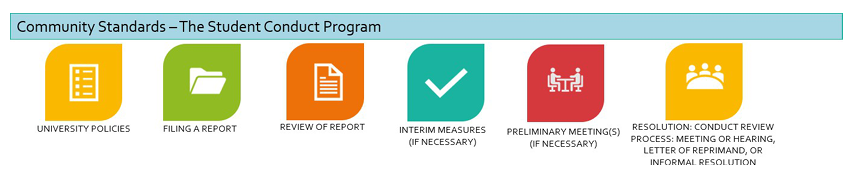
The path of a case will be determined by the Director of Community Standards or designee.
Filing a Report Any person may file a report concerning alleged violations of the Code of Student Conduct. This can be done by preparing a report in writing or by reporting to a staff member who will then write a report via Maxient. This should be done as soon as possible after the alleged misconduct happens. The longer it takes to file a report, the more difficult it becomes for University officials to obtain necessary information regarding a particular incident.
Review of Report Review of all alleged violations is overseen by the Director of Community Standards whose role is to identify those acts that may be in conflict with University policies. Alleged violations are determined by the Director of Community Standards or designee and then assigned to an appropriate conduct officer. Generally, three(3) business days’ notice is given prior to a meeting/hearing. If circumstances necessitate, the meeting/hearing may be scheduled immediately. Written notice, delivered electronically of the date, time, location, and alleged violation(s) is sent using the case management system and/or the student campus email account. If the student fails to attend the meeting/hearing, a decision will be made in the student’s absence.
Interim Measures The Vice Chancellor of Student Affairs or an Associate Vice Chancellor, or designee, may impose an interim measure before the completion of the conduct review process if there is a reasonable belief that:
- A student’s own safety and/or well-being is at risk;
- A student poses a threat to the health and/or safety of any member of the University community;
- A student poses a threat of disruption or interference with the normal operations of the University.
Interim measures may include, but are not limited to:
- Interim Suspension from Housing – While interim suspension from Housing status is in effect, a student is denied access to the residence hall and surrounding area.
- Interim Suspension from the University - While interim suspension from the University status is in effect, a student is denied access to classes, activities, and facilities.
- Campus Restriction - While campus restriction is in effect, a student is allowed access to classes; however, access to other activities, campus facilities, and campus property may be denied.
- No Contact Order - While a no contact order is in effect, a student is instructed not to engage in either direct or indirect contact with the Complainant(s) and witnesses. Methods of contact include, but are not limited to, verbal exchange, telephone, email, text message, letter, and communication via another party on the student’s behalf. No Contact Orders are ordinarily put in place for all students involved and are reciprocal. Electronic written notice will be given to all parties.
Following the imposed interim measure, the Conduct Review Process will continue as soon as practical with the appropriate path for the case. The interim measure will remain in effect until the student is notified, in writing, that the interim measure has been discontinued or until a final determination is made following the completion of the Conduct Review Process. A hold may be placed on a student with an interim measure in place.
A student who receives an interim measure may request within 1-2 business days, a meeting with the Associate Vice Chancellor or designee to discuss the interim measure. The student may provide information as to why an interim measure is not warranted. The Associate Vice Chancellor will determine based on information received if the interim measure should stay or be modified. Regardless of the outcome of this meeting, the student may still be referred to the Conduct Review Process.
The Vice Chancellor of Student Affairs or Associate Vice Chancellor or designee will monitor any administrative interim measure placed upon a student or student organization, and if information comes to light during the Conduct Review Process that warrants a different administrative interim measure or the removal of an action, that action shall be taken as soon as is reasonably possible.
If a student fails to comply with interim measures, further disciplinary action may be administered including but not limited to University Suspension.
Preliminary Meeting In some cases, it may be appropriate for the Director of Community Standards, or a designee to meet or speak with students who may have relevant knowledge about an incident. This investigative process allows the responding staff member to gain information to make decisions about proceeding with the Conduct Review Process. This step may or may not happen, it depends if there is a need for additional information to
continue with determining the path of the case.
Types of Case Resolutions
Informal Resolution: An informal resolution may transition into a formal meeting/hearing for any reason including new information learned during an informal meeting or when an informal resolution cannot be reached. Example of informal resolution can include:
- Educational letter, developmental conversation, or agreement
- Mediation. If mediation is deemed appropriate, contact will be made with all parties involved and an explanation of the process will be offered. If accepted by all parties, mediation will be viewed as an alternative solution. Should an agreement not be possible, the incident may be pursued through a conduct review meeting/hearing. All agreements reached through mediation are binding. If at any point the agreement is not fulfilled, the negligent party may face further conduct action.
Letter of Reprimand: A Letter of Reprimand may be sent to a student as a notice of a violation that has been documented. The Letter of Reprimand will instruct the student to refrain from repeating a behavior and will be placed in the student’s file. No further action will occur. This is a matter of record keeping and notice of a student’s decision- making pattern for a certain violation(s). Students receiving multiple Letters of Reprimand may be subject to further disciplinary action.
Conduct Review Meeting: The Director of Community Standards, or designee, will conduct the Conduct Review Meeting. This meeting is to be educational in nature. The student may take responsibility for the alleged violations or not. The goal of the meeting is to make a decision about responsibility and discuss the impact of the behavior(s) on the student and the campus community. This type of meeting can be for any level conduct case.
Administrative Hearing: The Director of Community Standards, or designee, will conduct the hearing. This hearing is to be educational in nature. The student may take responsibility for the alleged violations or not. The goal of the meeting is to make a decision about responsibility and discuss the impact of the behavior(s) on the student and the campus community. This type of hearing may be utilized for higher level cases and/or for a student whose conduct history is at a higher level or for cases that a possible outcome could be Suspension or Dismissal from the University. The hearing may be scripted and recorded as a matter of college record.
University Conduct Board Hearing: The Director of Community Standards will appoint three (3) UMass Dartmouth Faculty/Staff member(s), and/or student(s) who have been trained in the Conduct Review Process to comprise the University Conduct Board. One of the University Conduct Board members will be designated as the chairperson. This type of hearing can be utilized for higher level cases and/or for a student whose conduct history is at a higher level or for cases that a possible outcome could be Suspension or Dismissal from the University. The
goal of the hearing is to make a decision about responsibility and discuss the impact of the behavior(s) on the student and the campus community. The hearing may be scripted and recorded as a matter of University record.
After a decision has been made by the University Conduct Board, the chairperson will fill out documentation needed and turn all case materials back to the Director of Community Standards. The decision letter will be written from the Director of Community Standards or designee to the student.

The steps below specify the procedures that must be followed when determining if a violation has occurred and assures that due process is followed. The Maxient Case Management System will be used as the official management software for student conduct, all communication shall be sent to student’s University of Massachusetts Dartmouth email address.
- Notice - Students will receive a letter electronically from the appropriate University staff member, informing them of a conduct meeting/hearing to discuss the incident. Students must be given at least two (2) business days’ notice for meeting/hearing. The student will need to respond within 1 day (24 hours) if there is a schedule conflict. If no notification is received from the student, the meeting/hearing will proceed as indicated on the Notice of Violation.
- Attendance - If the student fails to attend the meeting/hearing, the review will be made in the student’s absence. Additionally, the student forfeits the right to appeal the decision and/or outcome of the case.
- Meeting/Hearing - A conduct officer/conduct board will review the incident report(s), documentation and/or related information with the student and the student will have the opportunity to share information regarding the incident. Since the meeting/hearing focuses on what happened with the purpose of determining whether policy violations have occurred, character statements, character witnesses, and letters of support that do not pertain to the incident in question cannot be considered. Students should only share information that pertains to the incident.
- Finding and Outcome - Based upon the information presented, the conduct officer / conduct board will determine if the student is responsible or not responsible for the alleged violation(s). Outcomes are considered only after responsibility has been determined and is based solely on the severity of the violation and a student’s previous conduct record. The decision of the case will be subject to final review by the Director of Community Standards or designee.
- Notice of Outcome - Students will receive a letter electronically notifying the student of the results of the meeting/hearing generally within five (5) business days following the meeting/hearing. Additional time may be needed if the case is complicated in nature and/or has numerous students involved.
- Appeal - The Student has the right to appeal based on appeal criteria within three (3) business days of the decision letter. (See Appeal Process Section for appeal criteria herein)
Appeal Process
The University has implemented procedures for students to appeal. Appeals are not re-hearing of the facts of the case, but rather an examination of the procedure and/or outcome. General dissatisfaction with the outcome of a conduct case or an appeal for mercy is not an appropriate basis for an appeal. The outcomes(s) resulting from a case decision will be considered on hold until the decision is affirmed, modified, or reversed in the appeals process.
Additionally, only a student who has participated in the conduct review process and has been found responsible for violating a policy may file a written appeal. If a student fails to attend a meeting/hearing, that student forfeits their right to appeal the decision rendered by the conduct officer or conduct board.
- An appeal must be made in writing via the Appeal form in the Maxient Case Management System (located on the Community Standards website) within (3) business days of the notification of the outcome of the case and should include the grounds for the appeal and all relevant information. Character statements, character witnesses, and letters of support that do not pertain to the incident in question cannot be considered. The decision to consider the appeal is a separate action from actually determining the appeal. If the appeal officer determines that the appeal does not meet any of the criteria for appeal, the student will be notified in writing via University email address within three (3) business days after the appeal request has been submitted.
The possible criteria for appeal are:
- The original meeting/hearing was not conducted according to established procedures or had significant procedural errors or irregularities that denied the student(s) a fair meeting/hearing.
- The student has new information that was not reasonably available prior to the original meeting/hearing and that information is likely to substantially change the outcome of the meeting/hearing.

All requests for appeal must outline the following:
Any appeal based on criterion “A” must include all of the following:
- Citation of specific procedural errors or irregularities with appropriate reference to the Conduct Review Process;
- Reason(s) why procedural error was not mentioned in the original meeting/hearing;
- Reason(s) why correction of error can contribute to a decision other than that which was originally made.
Any appeal based on criterion “B” must include all of the following:
- Nature of the new evidence;
- Name(s) of anyone who will present this evidence, include the new evidence in appeal submission;
- Reason(s) why evidence was not discussed at original meeting/hearing;
- Reason(s) why evidence can contribute to a decision other than that which was originally made.
The appeal officer may take the following actions after considering or determining an appeal:
- Affirm the original decision and outcome(s);
- Reverse the original decision and outcome(s);
- Affirm or reverse the original decision in part and/or alter the outcome(s) which could increase or decrease the severity of the outcome(s);
- Refer the matter to the original conduct officer to be reheard in whole or in part. At the discretion of the appeal officer a different officer or meeting/hearing method may be designated.
If an appeal meets at least one of the appeal criteria, the assigned appeal officer will review case related information. A notification of the decision regarding the appeal will be made to the student in writing via University email address. The appeal decision will generally be rendered within five (5) business days of the written appeal. The decision of the appeal officer is final and effective immediately, the case is closed. All outcomes must be completed as stated in the original Notice of Outcome and/or Notice of Appeal Decision letter.
Additional Conduct Review Process Guidelines
- All meetings/hearings will be held in closed session. Individual recording of case related materials, meetings, and hearings is prohibited by involved parties, witnesses, and advisors including but not limited to taking pictures, screenshots of documents, voice recording, video recording, etc. Failure to comply may result in additional disciplinary action.
- During summer, vacation periods, and in extenuating circumstances including but not limited to a natural disaster and/or global pandemic, the Director of Community Standards may approve alternative arrangements for individuals to participate in meetings/hearings including, but not limited to, the use of audio or video conferencing technology.
- If at any time during the course of a conduct meeting/hearing, any person exhibits behavior or language that is disruptive or threatening, that person may be dismissed with the process continuing without their presence or input.
- If requested in advance and determined to be an appropriate and reasonable accommodation through Student Accessibility Services, notices, reports and/or written materials can be provided in an alternate format. Students will need to contact the Office of Community Standards two (2) business days in advance and give permission for the Student Accessibility Services to disclose the accommodation necessary for approval of request. The student will need to give the Director of Community Standards permission to connect with Student Accessibility Services to talk about any accommodation that may be necessary to support the student.
- The Director of Community Standards or designee exercises discretion over the admission of any person into a meeting/hearing.
- A conduct officer / conduct board may record the meeting/hearing if it is deemed appropriate for the purpose of appeals or a matter of college record. This will be determined by the Director of Community standards. All individuals will be notified.
- For higher level conduct review, a meeting/hearing script may be used to help with consistency of process.
- The student can make an impact statement. This can be written ahead of time or within 24 hours after the meeting/hearing. If written in advance, the impact statement can be submitted to the conduct officer after being read during the meeting/hearing. The impact statement should address how this incident impacted them and how the possible outcome may impact them. It does not have to admit a level of responsibility.
- The student can present witness statement(s) in the meeting/hearings by giving prior notice to the Director of Community Standards and such statements one (1) business day in advance of the meeting/hearing for approval to be added to case information. Character witness statements will not be accepted.
- If a student is found responsible, the conduct officer or conduct board reviews the student’s full conduct record to decide if an outcome should be more severe based upon past conduct history. This information is not used to determine a student’s responsibility for alleged violations.
- Cases of alleged civil rights discrimination, harassment, sexual or gender harassment, domestic or dating violence, stalking, sexual assault or retaliation pursuant to university polices such as Non-Discrimination and Harassment Policy or Sexual Harassment will be referred to the Office of Civil Rights.
Outcomes/Educational Outcomes
There are a variety of possible outcomes you may receive if you are found responsible for violating a University policy. These outcomes range from disciplinary standing outcomes to educational outcomes to interventions. When a student is found responsible for a violation of the policies within the University Community Standards, any of the following types of outcomes may be assigned. Outcomes should be appropriate to the policy violation(s) for which they are assigned. When considering the outcomes to be imposed, a range of factors may be considered, including the:
- nature, context, and severity of an incident
- developmental needs of the student
- level of accountability and responsibility taken by the student
- level of cooperation from the student
- need to stop the misconduct and prevent its recurrence
- need to remedy and address the impact or effects of the conduct on others
- conduct history of the student
- best interests of the University community
- any other aggravating, mitigating, or relevant factors
Types of Outcomes:
Educational Outcome Students are expected to reflect upon their decisions and to be mindful of how their future choices and actions may impact themselves, others, and the campus community. Educational outcomes may include the following:
- Educational information provided to the student to review.
- Judicial Educator module – online module that relates to the violation of the incident.
- Participation or completion of a project, class, or other activity to build awareness or knowledge relevant to the nature of the offense or oneself, including research papers, personal reflections, workshops, organizing events, designing community education, or preparing an action plan.
- Mentorship with a specific person on campus.
- Requirement to attend, present and/or participate in a program related to the violation. It may also be a requirement to sponsor or assist with a program for others on campus to aid them in learning about a specific topic or issue related to the violation for which the student was found responsible. Audience may be restricted.
- Restorative actions - Requiring a student to engage in actions to investigate the impact of a violation and repair the harm resulting from misconduct on other members of the community. These actions may include letters of apology, drafting and implementing a plan of resolution, engaging in community events that build positive community.
- Mental Health/Medical Assessment and/or Treatment -Requirement that a student seek a mental health, medical, substance use, or threat assessment from Counseling Center or Health Services, or other appropriate professional and follow through with the recommendations of the professional.
- Additional or alternate Educational Outcomes may be created and designed as deemed appropriate to the violation.
Letter of Reprimand - A letter that makes a matter of record any incident that reflects unfavorably on the student behavior and is in violation of the policies outlined in the Code of Student Conduct. Please note that further violations of University policy may result in further disciplinary action.
University Warning - A written notice stating that a student has violated the Code of Student Conduct and that another violation may result in increased sanctioning. No further action will occur and is generally not appealable.
Campus Restriction - Restrictions or prohibitions on a student’s entry or access to particular locations, premises, or events, or on a students’ contact with another member of the University community. While the campus restriction is in effect, a student is allowed access to classes; however, access to any activities, campus facilities, and campus property may be denied.
Housing Relocation – At times it is best to relocate a student to another part of the residence area. This change in housing assignment will be done in consultation with the Office of Housing & Residential Education.
Financial Restitution - Restitution is monetary compensation required of students who have taken, misused, damaged, or destroyed University public, or private property or services. Amounts charged to students may include the cost to repair, replace, recover, clean, or otherwise account for the property or services affected.
Student Account/Disciplinary Hold - A hold may be placed on the student account. Students with a hold may not be able to receive grades, transcripts, diplomas, or be allowed to enroll in future classes at the University of Massachusetts Dartmouth. Holds will remain in place until the outcome is completed or course of action is resolved.
Community Restitution Hours – Community restitution hours may be assigned. A student would need to complete a specific number of hours with a specific department/office under the direct supervision of the department/office head.
Withdrawal of Recognition/Dissolution - Student groups may be disbanded, and University recognition withdrawn for a specific time period or permanently. Further, disciplinary action taken against a student group leader(s) may result in the organization receiving outcomes involving loss of recognition and/or privileges.
Administrative Fine - Fines are punitive monetary costs intended to dissuade students from violating the policies. Failure to pay a fine will result in a Student Account/Disciplinary hold on the student’s account.
Housing Probation - Shall be imposed for a period of 1-2 years. During this period a student found responsible of a violation of the Code of Student Conduct may be subject to immediate removal from University Housing. A student on Housing Probation shall not represent University Housing as an official delegate, representative, or as a holder of office or committee chair in University Housing groups of any kind.
Residential Housing Suspension/Removal from Housing - Separation of a student from University Housing without financial reimbursement. The student also loses the privilege to visit the residence halls or surrounding areas during the time of separation. This sanction is for a period of 1-2 years or could be permanent.
University Probation - Shall remain in effect for a specified period, generally not less than one year and not to exceed two calendar years from the time of the student conduct decision. During this period, a student found responsible for a violation through the Community Standards process may result in University Suspension or University Dismissal. A student under the sanction of University Probation shall not represent the University as an official delegate or representative, including participation in a Study Abroad program, athlete, or as a holder of office or committee chair in University groups of any kind.
Revocation of Admission or Degree may be revoked for fraud, misrepresentation, or another violation of the Code of Student Conduct, in the admissions process, in obtaining a degree, or for other serious violations committed by a student after admission or prior to graduation.
University Suspension - Separation of a student from the University without financial reimbursement. This prohibits the student from registering for classes or from attending the University while the suspension is in effect. University Suspension shall remain in effect for a specified period, generally not less than one year and not to exceed two calendar years from the time of the student conduct decision. During suspension, a student is banned from campus and may not participate in any University activity or program for the remainder of the separation. At the end of the specified period and after all sanctions have been completed the student may apply for re-enrollment using the Readmission Application found at http://www.umassd.edu/registrar/forms/. It is important to note that filling out the readmission application does not guarantee that a student will be readmitted.
University Dismissal – Permanent dismissal from the University without the right to return and without financial reimbursement. A dismissed student no longer has the privilege of matriculated students and may not engage in University activities, use any University facilities, or be on University property.
Alcohol and Drug Violation Outcomes Level System – UMass Dartmouth is committed to taking specific action in cases involving alcohol and/or drug violations. This Alcohol and Drug Level system is progressive, however there are instances where lower levels may be bypassed due to the nature of the incident.
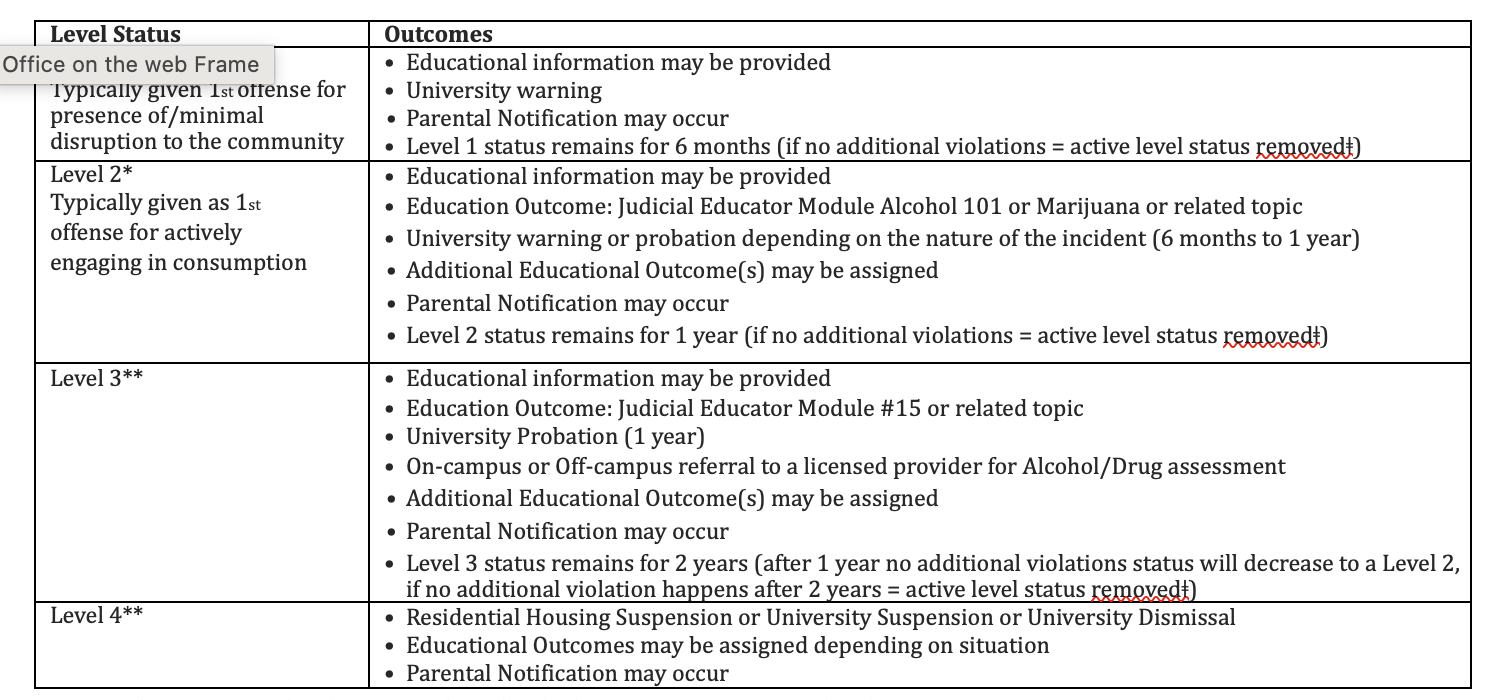
ǂ Active status level is removed as a level. The outcome stays in conduct history.
*A first incident in which medical treatment/transport may result in automatic placement on Level 2. Any additional incident in which medical treatment/transport may result in level increase of levels if already on a level.
* If campus police charge a student with a citation for an appearance in court for alcohol or drug related violation, an automatic placement on Level 2 or higher.
* Off-Campus Police/Authorities are involved and may result in automatic placement on Level 2 or higher.
** Drug Sale &/or Distribution may result in automatic Level 3 or Level 4.
NOTE: As part of the University’s compliance with the 1989 Drug Free School and Campuses Regulations (Drug-Free Schools and Communities Act, Public Law 101-226) and the policies of the Massachusetts Department of Higher Education is to set alcohol and illegal drug conduct code standards. In response to findings of code violations, the University will typically apply a minimum mandatory sanction. As minimum and mandatory these outcomes are aimed to provide an opportunity to examine one’s choices in light of complying with University standards as well as the Federal and State mandates and serve as a deterrent to future violations.
Fire Safety Violation Outcomes Level System UMass Dartmouth is committed to taking specific action in cases involving fire safety violations, which include covered smoke detectors, tampering with fire safety equipment, and or smoking/vaping in buildings. This Fire Safety Level system is progressive, however there are instances where lower levels may be bypassed due to the nature of the incident.
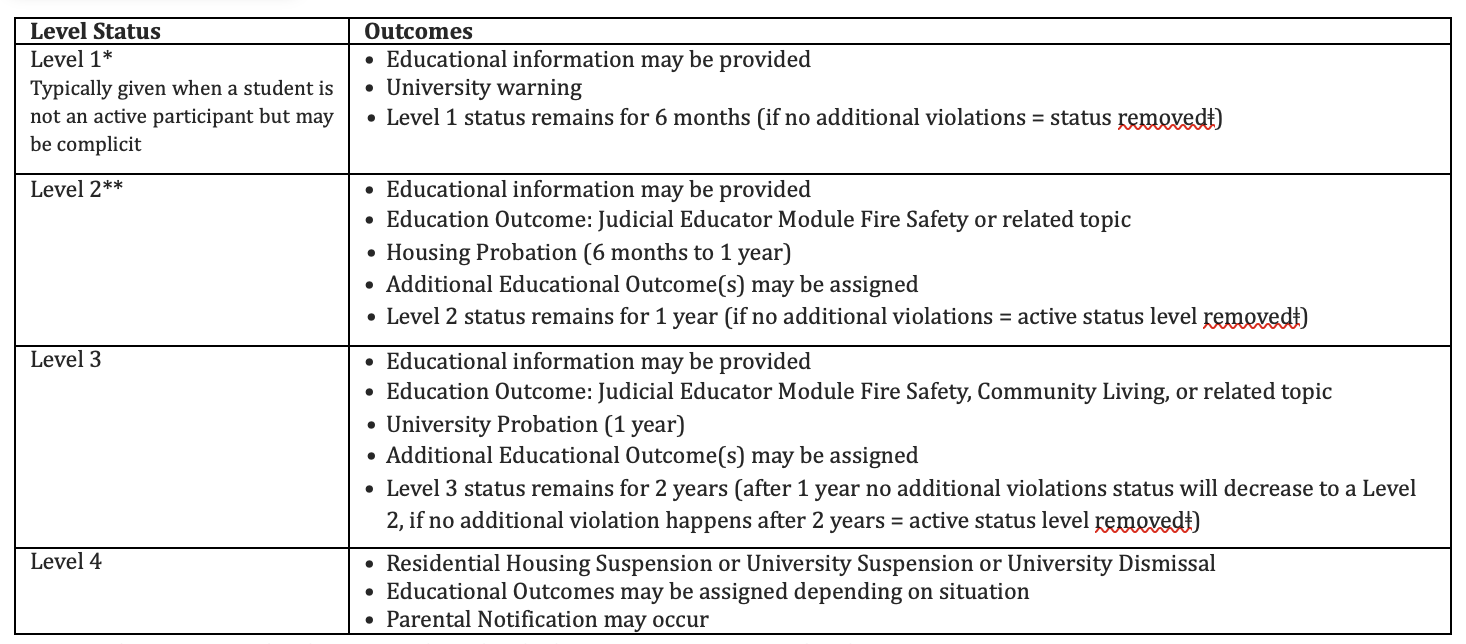
ǂ Active status level is removed as a level. The outcome stays in conduct history.
** If campus police charge a student with a citation for an appearance in court for fire safety related violation, an automatic placement on Level 2 or Level 3 depending on the severity of the incident.
Student Right to Know
| DISCLOSURE | SOURCE | OFFICE |
|---|---|---|
|
Academic related information & policies |
Provost Office |
|
|
Campus Security Report/Clery Report |
Security Report
|
University Policy Department |
|
Rights under the Family Education Rights and Privacy Act (FERPA) |
Registrars’ Office |
|
|
Title IX Polices & Process |
Office of Civil Rights |
|
|
UMass Dartmouth University Policies |
UMass Dartmouth |
|
|
Voter Registration |
Leduc Center for Civic Engagement |
Student Conduct Records
The Office of Community Standards shall maintain Community Standards records as they are deemed education records. Generally, records are not released without the written consent of the student; however, certain information may be shared if there is a legitimate legal or educational interest in obtaining it. For more information, please see the federal Family Educational Rights and Privacy Act of 1974.
- In general conduct records to be retained for 7 years from the last time the individual was a student.
- Suspensions from University records retained for 25 years
- Dismissals from University records retained indefinitely.
Graduate schools, professional schools, and University programs, field placement, positions working at the University may request information to inquire if the student is in good conduct standing. The Director of Community Standards or designee will review student conduct history to determine good conduct standing. All conduct verification requests should be submitted in writing to the Office of Community Standards.
For graduate schools and professional schools, a signed release is required in order for the Office of Community Standards to respond to the request, this is also true for transfer request forms. A student can request a meeting with the Director of Community Standards to review their conduct file and check disciplinary standing.
Students may arrange to review their own conduct record by contacting the Office of Community Standards.
Code of Student Conduct Interpretation and Revision
- All questions regarding interpretation of the Code of Student Conduct shall be referred to the Director of Community Standards for final determination.
- The Code of Student Conduct shall be reviewed on behalf of the Vice Chancellor of Student Affairs as requested.
- Revisions in this current document are: September 2, 2026
- Additional violations:
- Bicycle, Scooter, and Micro-Transportation
- Unauthorized Access/Presence &/or Use of Facilities, Equipment, and Vehicles
- Clarification on Records Retention
Grievance Concerns Complaints, grievances, or disagreements arising from or among students at University of Massachusetts Dartmouth should be handled, as far as possible, directly by the students involved and peacefully. Students are encouraged to resolve personal disagreements before they cause major concerns or prior to violating University policy. If a student needs assistance working out a problem of this sort, the student can speak with the University Staff and Faculty. Having a third party can often prove very helpful when serving as a sounding board or mediator.
- Complaints concerning alleged violations of Equal Opportunity and Title IX (i.e. discrimination, sexual harassments, ADA, Title IX, etc.) should be directed to the Office of Civil Rights.
- Academic related complaints or grievances should follow the Academic Policies. Students can contact the Office of the Provost.
- Complaints or grievances directed at a faculty or staff member of the University should be taken up with that individual’s supervisor. If you are unsure, who you can contact you can contact the Student Affairs Vice Chancellor or Associate Vice Chancellors for guidance.